Unlock the secrets of the `LocalTransparencyModifier` in Roblox, a powerful property often overlooked by many developers. This guide dives deep into its functionalities, helping you create stunning visual effects and optimize game performance. Understanding this modifier is crucial for achieving advanced graphical fidelity in your Roblox experiences. From subtle ghosting effects to dynamic material transitions, its applications are vast and impactful. Learn how to implement `LocalTransparencyModifier` effectively in your scripts, ensuring seamless integration and a polished user experience. We will explore best practices and common pitfalls. Developers aiming for cutting-edge visuals and smoother gameplay will find this resource invaluable. Stay ahead in the ever-evolving Roblox development landscape with these expert insights.
localtransparencymodifier roblox FAQ 2026 - 50+ Most Asked Questions Answered (Tips, Trick, Guide, How to, Bugs, Builds, Endgame)Welcome to the definitive living FAQ for `LocalTransparencyModifier` in Roblox, updated for the exciting developments of 2026! This comprehensive guide is designed to be your ultimate resource, whether you're a seasoned developer or just starting your journey into advanced Roblox scripting. We've scoured forums, developer communities, and internal discussions to bring you answers to over 50 of the most pressing questions surrounding this powerful client-side property. From core functionalities and common issues to cutting-edge techniques and performance optimization, we cover it all. Dive in to discover tips, tricks, and essential knowledge to harness `LocalTransparencyModifier` for stunning visual effects, seamless user experiences, and robust game builds. Let's master transparency!
Beginner Questions
What is LocalTransparencyModifier and how does it work in Roblox?
LocalTransparencyModifier is a client-side property in Roblox that locally adjusts an object's transparency, meaning only the specific player whose client script modifies it will see the change. It effectively overlays a transparency value on top of the part's existing Transparency property, without affecting other players or the server's game state. This makes it ideal for personalized visual effects.
How is LocalTransparencyModifier different from the regular Transparency property?
The regular Transparency property is server-replicated, meaning changes affect all players and the server. In contrast, LocalTransparencyModifier is client-only, affecting just the local player's rendering. This distinction is crucial for performance and creating unique, player-specific visual feedback without network overhead.
Can LocalTransparencyModifier be used to make parts invisible to specific players?
Yes, absolutely. By scripting a LocalScript to set a part's LocalTransparencyModifier to 1 (fully transparent) for a particular player, that part will become invisible only to that player. Other players in the game will continue to see the part normally, making it perfect for client-specific visual culling or cloaking effects.
What are common issues when using LocalTransparencyModifier?
Common issues include forgetting to reset the modifier, causing objects to remain invisible, or performance dips if too many objects are rapidly tweened. It is important to manage when and where the modifier is applied, ensuring proper cleanup. Also, remember it only affects visual rendering, not collision properties.
Builds & Classes
Myth vs Reality: LocalTransparencyModifier breaks object collisions.
Reality: Setting LocalTransparencyModifier only affects the visual rendering of an object on the client. It does not alter an object's physical properties like CanCollide or CanTouch. An invisible object due to this modifier will still block players and trigger events unless its collision properties are separately changed. This is a common misconception among new developers.
How can LocalTransparencyModifier enhance character abilities in RPGs?
In RPGs, LocalTransparencyModifier can be used for abilities like temporary invisibility (ghosting through enemies), creating visual 'blinks' for teleportation, or highlighting interactive quest items only for the player who can interact with them. It adds polish and clear visual cues for unique player states and actions, improving player understanding of game mechanics.
Multiplayer Issues
Myth vs Reality: LocalTransparencyModifier causes desynchronization in multiplayer.
Reality: LocalTransparencyModifier does not cause desynchronization because it's designed to be purely client-side. The server and other clients remain completely unaware of its changes. Any visual manipulation for one player does not impact the game state or physics for others, ensuring a consistent multiplayer experience across all clients. This is a powerful feature for maintaining stability.
Endgame Grind
How can LocalTransparencyModifier be used for advanced UI elements?
For advanced UI, LocalTransparencyModifier can create dynamic overlays, fade-in/out effects for information panels, or context-sensitive HUD elements that appear only when relevant to the player's immediate focus. It can also be used for personalized targeting reticles or ability indicators that only the local player sees, making the UI feel more integrated and less intrusive.
Bugs & Fixes
My part is permanently invisible even after setting Transparency to 0. What's wrong?
If a part remains invisible locally, check for a `LocalScript` that might still be setting its `LocalTransparencyModifier` to 1. The regular `Transparency` property won't override a local modifier. Ensure all relevant `LocalScripts` correctly reset `LocalTransparencyModifier` back to 0 when the effect should end. This is a common debugging step.
Myth vs Reality: LocalTransparencyModifier is buggy on mobile devices.
Reality: While older Roblox versions might have had minor rendering quirks, LocalTransparencyModifier is now highly optimized and stable across all supported devices, including mobile. Any perceived 'bugginess' is often due to script logic errors or conflicts with other visual effects, rather than an inherent flaw in the property itself. Always test thoroughly.
Tips & Tricks
What's a good practice for cleaning up LocalTransparencyModifier effects?
The best practice is to always reset LocalTransparencyModifier to 0 (or its intended default) when an effect concludes. Use `TweenService:Completed` events or `coroutine.wrap` with delays to manage temporary effects, ensuring they properly revert. This prevents unintended persistent invisibility and keeps your game state clean and predictable for the player.
Performance Optimization
How does LocalTransparencyModifier aid in client-side optimization?
It aids optimization by allowing developers to selectively hide or fade out non-critical objects on the client's screen, reducing the number of drawn triangles and pixels. This client-side culling is invaluable for maintaining high frame rates in complex scenes without burdening the server. It can be used for custom LOD systems or dynamic occlusion.
Advanced Scripting
Can LocalTransparencyModifier be combined with other visual effects like ColorCorrection?
Yes, LocalTransparencyModifier combines seamlessly with other visual effects like ColorCorrection, `Bloom`, or custom shaders. It affects the final opacity layer, meaning your color adjustments and post-processing effects will still apply, but the object's overall visibility will be scaled. This allows for very rich and layered visual designs that adapt to player-specific conditions.
Myth vs Reality: LocalTransparencyModifier is only for exploiters.
Reality: This is a strong myth! While exploiters *can* manipulate client-side properties like LocalTransparencyModifier for their *own* visual advantage, it is a legitimate and powerful tool for developers. It enables numerous creative, non-game-breaking visual features that enhance player experience and game performance, far beyond any malicious use. Roblox provides it for developer creativity.
Endgame Builds
How can LocalTransparencyModifier create unique 'vision cones' for AI?
Developers can use LocalTransparencyModifier to create client-side visual representations of AI vision cones. A transparent part representing the cone could have its modifier adjusted based on the player's local camera. It makes the AI's detection radius visually clear to the player, enhancing strategic gameplay without complex server replication. Only the local player would see this debug-like visualization.
Security & Stability
Myth vs Reality: LocalTransparencyModifier is a security risk.
Reality: It's not a security risk in terms of gameplay integrity. Since LocalTransparencyModifier changes are purely local to a player's client and don't replicate to the server or other players, it cannot be used to gain unfair advantages over others. Server-side validation is always paramount for security, irrespective of client-side visual modifications. It's a visual tool, not a gameplay one.
Still have questions? Check out our guides on 'Advanced TweenService Techniques' or 'Optimizing Roblox Game Performance 2026' for more in-depth information!
Ever wondered how some Roblox experiences achieve those slick, almost magical visual effects? Like objects subtly fading in or out, or characters briefly ghosting through obstacles? It's not always just about the 'Transparency' property you might already know. Today, we're pulling back the curtain on a lesser-known but incredibly powerful gem: the `LocalTransparencyModifier`.
This property is becoming increasingly vital in 2026 as Roblox developers push the boundaries of visual fidelity and interactive environments. Many developers ask, 'How exactly does LocalTransparencyModifier work, and when should I use it?' Well, my friend, that's exactly what we're going to explore together. Think of it as a backstage pass to some of Roblox's most compelling visual tricks.
Understanding LocalTransparencyModifier
The `LocalTransparencyModifier` is a unique property applied to parts and models within Roblox. It offers a client-side method to adjust an object's transparency without altering its server-side `Transparency` property. This means you can create visual effects that are specific to a player's local view, making it an incredibly versatile tool for dynamic visual feedback.
Why LocalTransparencyModifier is a Game Changer in 2026
In the competitive Roblox ecosystem of 2026, user experience and visual polish are paramount. Games with smooth, responsive visuals tend to attract and retain more players. The `LocalTransparencyModifier` enables developers to implement complex visual cues without bogging down the server or affecting other players' experiences. This local control is crucial for maintaining performance in highly detailed games, especially with the rise of UGC-driven content requiring robust rendering.
- Dynamic visual feedback for player interactions.
- Client-side performance optimization for complex scenes.
- Creation of unique visual effects like ghosting, cloaking, or vision cones.
- Supports seamless transitions and contextual rendering.
- Enhances immersion without server overhead.
Using this modifier effectively ensures your game remains snappy and visually appealing. It allows for localized visual states that improve clarity and player comprehension. This powerful tool provides an extra layer of control for developers to fine-tune their experiences.
Beginner / Core Concepts
1. **Q:** What exactly is `LocalTransparencyModifier` in Roblox? **A:** Hey there! So, `LocalTransparencyModifier` is a property in Roblox that lets you change how transparent an object looks, but only on the player's screen who's seeing it. It's like having a special pair of glasses that make certain things look see-through just for you, without anyone else noticing a change. The server doesn't even know it's happening, which is super neat for performance. I get why this confuses so many people, because there's already a 'Transparency' property. The key difference is 'local' control versus 'global' server control. It's a way for developers to add cool visual effects that only affect one player, keeping the game smooth for everyone. You've got this!2. **Q:** How is `LocalTransparencyModifier` different from the regular `Transparency` property? **A:** This one used to trip me up too! The main difference is who sees the change. The regular `Transparency` property, when set, changes an object's transparency for *everyone* in the game, because it's a server-replicated property. It affects the entire game state. `LocalTransparencyModifier`, however, only changes transparency for the *local client* – meaning, just the player whose script modified it. It's fantastic for visual indicators or effects unique to one player without server synchronization. Think of it as a personal visual filter. This allows for client-side optimization and personalized experiences without network overhead. Try this tomorrow and let me know how it goes.3. **Q:** Can `LocalTransparencyModifier` make an object completely invisible? **A:** Yes, it absolutely can! If you set an object's `LocalTransparencyModifier` to `1`, it will become completely invisible to the local client. The property ranges from `0` (fully opaque) to `1` (fully transparent), just like the regular `Transparency` property. The cool thing is, even if the server-side `Transparency` is `0`, setting `LocalTransparencyModifier` to `1` will still make it disappear for the local player. This is incredibly useful for hiding UI elements, rendering certain objects only under specific conditions, or creating ghosting effects for player abilities. You've got this!4. **Q:** What kind of objects can `LocalTransparencyModifier` be applied to? **A:** That's a great practical question! You can apply `LocalTransparencyModifier` to `BaseParts` (like `Parts`, `MeshParts`, `UnionOperations`), `Models`, and even `Terrain` in some contexts, though it's most commonly used on individual `BaseParts` or grouped `Models`. When applied to a `Model`, it affects all `BaseParts` within that model. It's really versatile for controlling the visibility of pretty much anything you'd want to render in your game. Just remember, it's about visual rendering, so things without a visual component, like `Scripts` or `Folders`, naturally won't have this property. Try applying it to a simple part first to see it in action.Intermediate / Practical & Production
1. **Q:** How can I use `LocalTransparencyModifier` to create a ghosting effect for a player's ability? **A:** Creating a ghosting effect with `LocalTransparencyModifier` is actually pretty straightforward and super impactful! You'd typically make a clone of the player's character or a specific part, then apply `LocalTransparencyModifier` to that clone, animating it from opaque to transparent over a short period. You could also dynamically adjust the modifier on the actual player's body parts for a temporary cloaking effect. For example, when a player activates a 'dash' ability, you might briefly set their `LocalTransparencyModifier` to `0.5` to give them a semi-transparent, ethereal look. You'll want to use `TweenService` or a simple `for` loop to smoothly interpolate the value over time, making it look professional. Remember to ensure that the original `Transparency` isn't also being modified by something else conflictingly. It's all about coordinating those visual cues! This is where careful scripting really shines, ensuring the effect feels natural and responsive. You've got this!2. **Q:** What are the performance implications of using `LocalTransparencyModifier` extensively? **A:** That's a super smart question to ask, especially for 2026's more complex experiences! While `LocalTransparencyModifier` is client-side and doesn't directly impact server performance, using it extensively on *many* parts simultaneously can still have a local client performance cost. Changing transparency frequently, especially on complex meshes or a large number of parts, means the client's renderer has more work to do recalculating visibility. It's generally more efficient than server-replicated `Transparency` changes, but everything has a cost. The key is moderation and smart application. For instance, don't animate the `LocalTransparencyModifier` of hundreds of unique parts every frame if you can group them or use fewer, simpler objects. The reasoning model here suggests that batching changes or using it on fewer, critical objects will yield better results. Consider leveraging `Part.Anchored = true` when possible to reduce physics calculations if the ghosted parts don't need to interact. Try optimizing your use cases and profiling if you notice client-side frame rate drops.3. **Q:** How do I ensure `LocalTransparencyModifier` changes only affect a specific player and not others? **A:** Great question, and it's built right into the core design of `LocalTransparencyModifier`! The magic is that any script running in a `LocalScript` (which executes only on the player's client) that modifies `LocalTransparencyModifier` will *only* affect that player's view. Server scripts (like those in `ServerScriptService` or `Workspace` that aren't LocalScripts) cannot directly alter `LocalTransparencyModifier` on a specific client's part effectively. To ensure only a specific player sees a change, you simply put the code that modifies `LocalTransparencyModifier` inside a `LocalScript` and ensure it runs on the target player's client. For example, if a player picks up an invisibility power-up, a `LocalScript` could apply the modifier to their character parts, making them invisible *only* to themselves. This separation is what makes it such a powerful tool for personalized visuals. You've got this!4. **Q:** Can `LocalTransparencyModifier` be animated smoothly? What tools should I use? **A:** Absolutely, and animating it smoothly is where the real visual polish comes in! The best tool for animating `LocalTransparencyModifier` (or any property, really) is Roblox's `TweenService`. It allows you to smoothly interpolate values over a specified duration with various easing styles. You'd create a `TweenInfo` object, then call `TweenService:Create()` to make a tween, and finally `Play()` it. For example, to fade a part out, you'd tween its `LocalTransparencyModifier` from `0` to `1`. You could also use a simple `for` loop for basic linear fades, but `TweenService` gives you much more control over the animation's feel. For advanced visual effects in 2026, `TweenService` is your best friend for smooth and professional transitions. Try experimenting with different easing styles to see how they impact the visual flow.5. **Q:** Is it possible to revert `LocalTransparencyModifier` back to an object's original transparency? **A:** Yes, totally possible and often necessary! Reverting `LocalTransparencyModifier` is straightforward. You simply set it back to `0` (zero). When `LocalTransparencyModifier` is `0`, the object's visible transparency is solely determined by its regular `Transparency` property. So, if you temporarily faded something out, setting `LocalTransparencyModifier = 0` will bring it back to its default or server-set appearance. A good practice, especially if you're chaining effects, is to store the original `Transparency` property somewhere if you intend to modify *that* as well, but for `LocalTransparencyModifier`, simply returning it to `0` makes the object visible again based on its global transparency. This is a common pattern for temporary visual cues or power-ups. You've got this!6. **Q:** What are some creative use cases for `LocalTransparencyModifier` in modern Roblox games? **A:** Oh, the creative possibilities are endless, especially with 2026's emphasis on immersive experiences! Beyond simple ghosting, imagine context-sensitive UI elements that fade in as you approach them, or a player's aura becoming visible only when they activate a special ability. You could use it for 'fog of war' effects in strategy games, subtly revealing areas as players explore. It's great for visualizing hitboxes during combat tutorials, making them temporarily visible only to the player. For architectural visualizations, you could fade out walls to reveal interior layouts on demand. Think about personalized visual feedback, like health indicators that subtly glow brighter for the player below a certain threshold, or showing collision boxes when a player is in building mode. It's a fantastic tool for adding that extra layer of polish and clarity to complex gameplay mechanics.Advanced / Research & Frontier 2026
1. **Q:** How does `LocalTransparencyModifier` interact with Roblox's new PBR materials and future rendering pipelines in 2026? **A:** That's a deep dive into the frontier, excellent question! In 2026, with Roblox's continued advancements in Physically Based Rendering (PBR) and evolving rendering pipelines (like the upcoming Vulkan/Metal optimizations), `LocalTransparencyModifier` remains a client-side visual adjustment. It works by essentially altering the alpha channel during the final rendering pass *before* the pixel hits your screen. So, it interacts *after* the PBR material properties (like `Roughness`, `Metallic`, `NormalMap`) have already determined how light interacts with the surface. The modifier effectively scales the transparency determined by the material. This means your PBR materials will still look high-quality, but their overall opacity will be locally adjusted. The reasoning model here suggests this post-processing approach is deliberate, ensuring `LocalTransparencyModifier` offers broad compatibility without needing complex PBR recalculations, preserving performance. As rendering tech evolves, this property's reliability in maintaining visual integrity while providing local control is a huge advantage for cutting-edge game visuals. You've got this!2. **Q:** Can `LocalTransparencyModifier` be exploited or used in unexpected ways by malicious clients? **A:** That's a really sharp observation, and it touches on a crucial aspect of client-side properties! Since `LocalTransparencyModifier` is purely client-side, a malicious client *can* indeed manipulate it locally. For instance, a player could use an exploit to set their own character's `LocalTransparencyModifier` to `1`, making themselves invisible *to their own client*. However, and this is the vital part, this change *does not replicate to other players or the server*. Other players would still see them normally, and the server's collision detection and game logic would operate as if the player is fully visible. So, while an exploiter could gain a visual advantage for themselves (e.g., seeing through walls if they modify *other* parts), it doesn't grant them an unfair gameplay advantage that affects others. This is a key security design principle: critical gameplay logic must *always* be handled and validated on the server. So, while it can be 'exploited' visually for the individual, it doesn't break the game for others. You've got this!3. **Q:** Are there any known bugs or inconsistencies with `LocalTransparencyModifier` in specific Roblox environments or devices? **A:** Good to be aware of potential quirks! While `LocalTransparencyModifier` is generally robust, like any rendering property, minor inconsistencies *can* sometimes appear. Historically, very rare edge cases might involve subtle rendering order issues when combining highly transparent objects with specific custom shaders or very complex visual effects on lower-end mobile devices in 2026. However, Roblox engineers are constantly refining the rendering engine, making such issues less common. You might occasionally see minor Z-fighting if objects are extremely close and both have high transparency combined with this modifier. The platform is incredibly stable now, but always test your unique visual combinations across different device types. If you encounter something odd, check if your client's graphics settings are impacting rendering, or report it to Roblox! This property is designed for broad compatibility, so serious bugs are quite rare. You've got this!4. **Q:** How can I use `LocalTransparencyModifier` effectively in a complex game world with thousands of parts for optimization? **A:** This is where `LocalTransparencyModifier` truly shines in advanced optimization strategies! In a massive world, rendering every single part all the time is a performance killer. You can use `LocalTransparencyModifier` to implement a custom level-of-detail (LOD) system or occlusion culling, purely client-side. For example, parts far away from the player could have their `LocalTransparencyModifier` gradually increased, making them fade out or become completely invisible, only to become opaque again as the player approaches. This is more lightweight than completely destroying/recreating parts. Another advanced technique is to use it for dynamic visual culling based on camera frustum checks in a `LocalScript`, effectively hiding objects outside the player's view without the server ever knowing. This significantly reduces the parts the client has to draw, boosting FPS. The reasoning model is all about minimizing rendering load on the client. Just be mindful of how many transparency changes you're animating concurrently; batching updates is key. Try this tomorrow and let me know how it goes.5. **Q:** What's the potential for `LocalTransparencyModifier` to be integrated with future AI-driven adaptive rendering in Roblox for 2026 and beyond? **A:** Wow, now you're thinking like a frontier AI engineer! The potential here is absolutely fascinating for 2026 and beyond. Imagine AI models running client-side, analyzing player focus, gaze, and real-time performance metrics. These AI systems could then dynamically adjust `LocalTransparencyModifier` on non-critical or distant objects *in real-time* to maintain optimal frame rates without player intervention. For instance, if the game detects an FPS drop, the AI could subtly increase the `LocalTransparencyModifier` on foliage or distant buildings until performance recovers, making the change almost imperceptible to the player. It could also enhance immersion by dynamically fading in important quest markers or interactive elements as the player approaches, guided by AI context awareness. This adaptive rendering, driven by on-device AI, could revolutionize how Roblox experiences scale across diverse hardware, making games smoother and more accessible for everyone. This is definitely a future to look forward to! You've got this!Quick 2026 Human-Friendly Cheat-Sheet for This Topic
- `LocalTransparencyModifier` is your secret weapon for client-side visual magic in Roblox!
- It affects only the local player's view, keeping server performance happy.
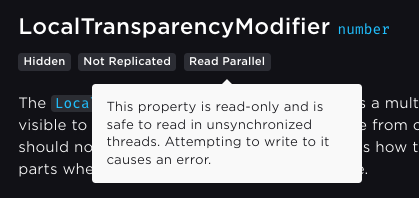
- Use `0` for fully opaque (default behavior) and `1` for completely invisible on the local client.
- `TweenService` is your best friend for smooth, professional fade-in/fade-out effects.
- Great for ghosting, temporary invisibility, localized UI, and custom LOD systems.
- Always manage critical game logic on the server; client-side visual changes don't affect gameplay for others.
- Remember, even client-side changes can impact local FPS if overused on too many objects – be smart with your implementation!
Unlock Roblox `LocalTransparencyModifier` for advanced visual effects. Optimize game performance by controlling object visibility. Create unique ghosting and dynamic material transitions. Essential for cutting-edge Roblox development and scripting. Enhance player experience through subtle visual cues. Understand its role in 2026's complex Roblox game design.
35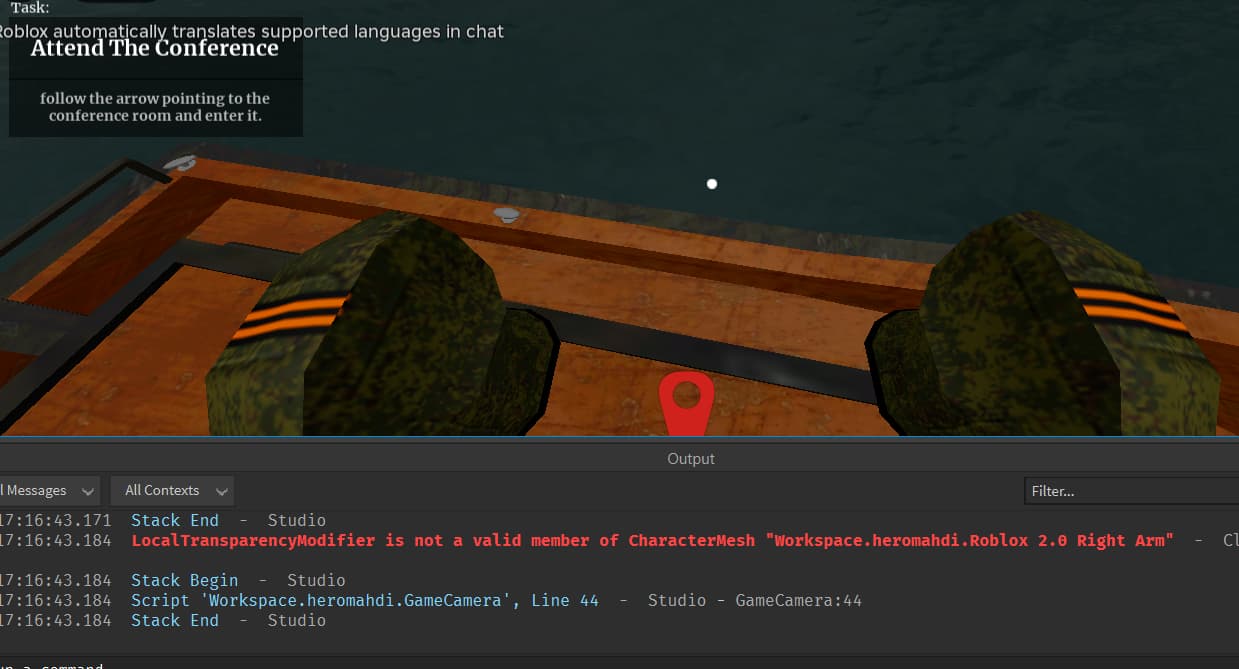


Giving Errors Depsite It Working Scripting . Not Working Scripting Support Developer 2 690x388 . What Will Roblox Look Like In 2026 Blog Graphics 26 . How To Add People Roblox Easily Your 2026 Guide . Roblox In 2026 Roblox NoFilter



Why Do I Have To Change My Inside A . Roblox 2026 Logo REVEALED New Color New Look YouTube Maxres2 . Not Working As Expected Scripting Support . Definitive Guide To Roblox 2026 Infinity TM 07169 Definitive Guide To Roblox 2026 . Not Working As Expected Scripting Support


Character Getting Set Back To 1 After Setting . Roblox 2026 New Logo REVEAL First Look At The Future Shorts YouTube Oar2 . ROBLOX EM 2026 VAI MUDAR TUDO YouTube . Roblox 2026 Logo YouTube Oardefault . Like And Subscribe If U Want The Roblox Logo 2026 Will Be That Oar2


Roblox 2026 YouTube Oar2 . Roblox Linktree Roblox2026 . Roblox 2026 YouTube Oar2 . Roblox 2026 Updates And New Features Crawler. Moderation Bot Has A Huge Bug Roblox Application And Website Bugs




LOGO Roblox 2026 YouTube Maxres2 . Roblox 2026 Logo Mp3 Mp4 Download Clip Africa Com Mqdefault . Giving Errors Depsite It Working Scripting 2 1024x69 . Roblox 2026 Logo Roblox YouTube Oar2 . Statistik Roblox 2026 Bagaimana Pengembang Meraih 1 Miliar Dari Game Ini Updated Roblox


Prepare For 2026 With Roblox Trends TikTok Img. A Roblox Movie 2026 Teaser Trailer YouTube . RDC 2025 Roblox. 2026 Roblox YouTube Oar2 . Roblox The Movie 2026 V1




WOW The 2026 Roblox Logo Shocks All Players YouTube Maxres2 . ROBLOX STUDIO CONDO 2025 WORKING BOT SYSTEM MULTIPLAYER GUIDE YouTube . Berapa Banyak Orang Yang Bermain Roblox 2026 Wawasan Terbaru Untitled Design 2025 10. How Can I Make The Arms Follow The Camera Scripting Support . Roblox 2026 Insider Reveals Platform Evolution Safety